
The fee is $220 – $300 for an hour-long (50-minute) appointment and $330 – $450 for an hour-and-one-half (75-minute) appointment.
We are committed to efficiency, so we’re oriented more to problem resolution than exploration. As brief therapists, we challenge the assumption that long-standing or seemingly intractable problems require long-term therapy. We won’t end our work together before you’re ready to stop, but from the outset we’ll be laying the groundwork for you not
needing us anymore.
We are not on any insurance panels, and we don’t bill insurance companies. This means that you will need to pay out-of-pocket for your sessions; however, we can help you if you wish to use your insurance to help defray the cost of therapy. We will provide you with a receipt that will allow you to get reimbursed at whatever rate your insurance company has set for out-of-network providers, and we’ll talk with them if you need us to. We are both licensed marriage and family therapists (LMFTs). Almost all insurance companies accept this license for psychotherapy with individuals, couples, and families, but just to be sure that this is true for your plan, give them a call to double check that they will cover your working with us. We both have Blue Cross Blue Shield provider numbers, so if you have BCBS insurance, the reimbursement should be even more straightforward.
For you to receive insurance reimbursement for your sessions, we will need to give you a DSM or ICD-10 diagnosis. We’ll talk to you about this in your first session.
Our telehealth app, Simple Practice, accepts all major credit, debit, FSA, and HSA cards. The company offers bank-level security, so you can safely put your card on file and we’ll bill it after our appointment.
Because CBT is manualized, researchers have studied it extensively, and the results of these studies have made their way into the popular press. This has led the general public, including referring professionals such as doctors, to conclude that there is something uniquely effective about the approach. But such is not the case. Although it is practiced by clinicians we respect, we take issue with some its tenets and common techniques, so we’ve never been drawn to it. If you’re interested in the research conducted on our approach, let us know and we’ll direct you toward the relevant studies.
Over the course of 10 years as a professor at Nova Southeastern University, Shelley created, developed, practiced, and taught a brief, relational approach to equine assisted family therapy, so it is in her blood. She brings the spirit of this work into therapy with individuals, couples, and families; however, since our work is currently exclusively telehealth, she does not offer equine assisted sessions.
If you work with a hypnotherapist who is an ethical, licensed clinician, the process will be as safe as any therapeutic undertaking. Douglas won’t “hypnotize” you; he’ll respectfully facilitate a mind-body connection that feels both safe and thoroughly collaborative.
Sure, but to do so will require a quick dip into music theory. Music is an apt metaphor for our therapeutic work because interwoven musical structures are patterns, expressed through time, between notes (melody) and clusters of notes (harmony). Similarly, the patterns we attend to in our practice are those that play out, also through time, between individuals, between individuals and their social and physical environments, and between individuals and their experience.
Our 12-pointed star—
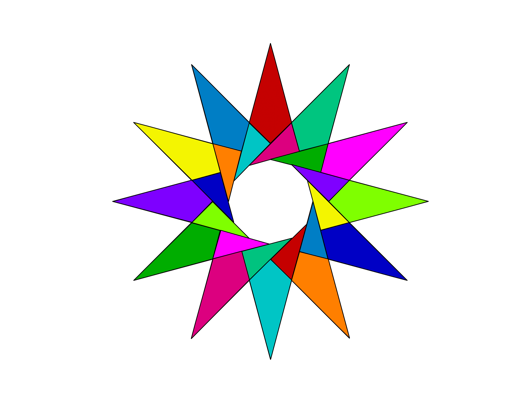
—is designed to illuminate the interconnected patterning of such relationships.
In Western music, there are 12 notes in the chromatic scale—easily identified on a piano keyboard:
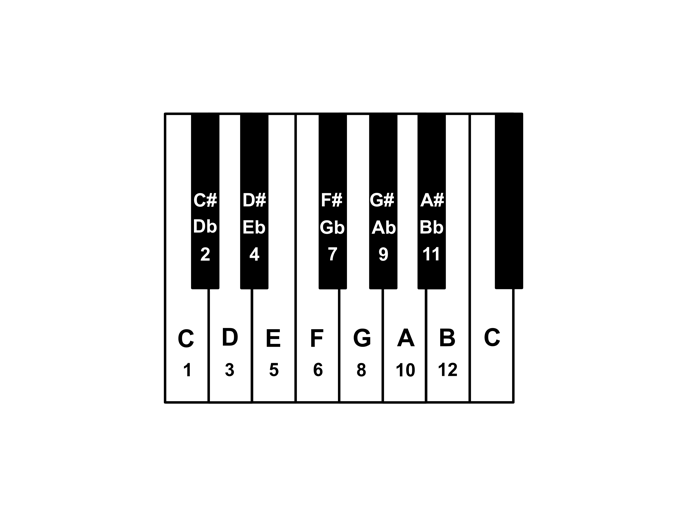
Each of these 12 notes is also the name of a key or scale—a set or grouping of (usually) seven notes from which song writers choose most of the notes of their melodies. The key of C, for example, is comprised of all the white notes of the piano: C D E F G A B; the key of D includes two black notes: D E F# G A B C#; and so on.
There is a way of arranging these 12 notes in a circle, such that, moving clockwise, each successive note is the fifth note of the scale of the note that precedes it. The arrangement is called the circle of fifths:
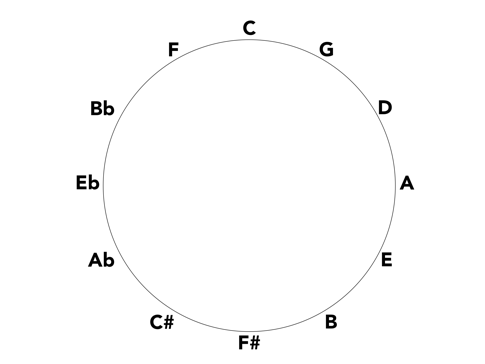
The fifth note of the C scale is G (C D E F G A B), the fifth note of the G scale is D (G A B C D E F#), the fifth note of the D scale is A (D E F# G A B C#); and so on. The harmonic movement of much Western music is organized by this relationship among 5ths.
Now, if, on the circle of fifths, you trace, from C, either an ascending or descending chromatic scale (C-C#-D-Eb-etc. or C-B-Bb-A-etc.), you will inscribe a 12-pointed star.
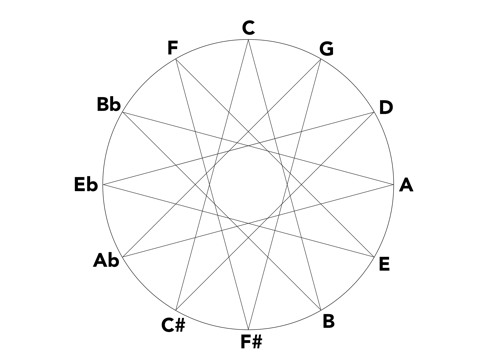
Hold that thought as we step over to color theory. One way of defining the relationship between colors is on a 12-spoked wheel, anchored by a triangle of red, green and blue.
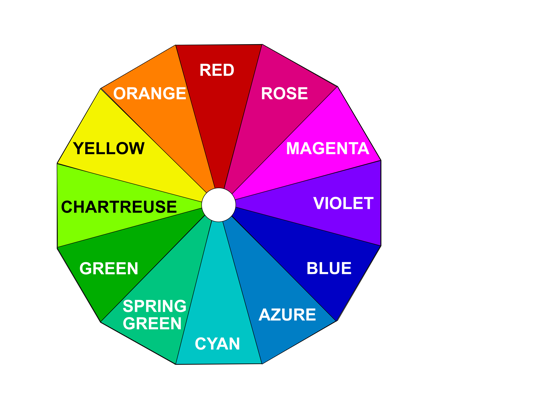
If these colors are mapped onto the 12 notes of the chromatic scale—
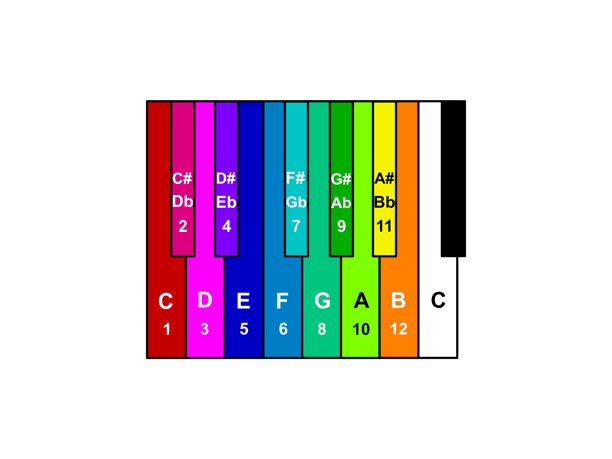
—then they can also be arranged in accord with the placement of their associated note on the circle of 5ths. The result is the 12-pointed star of our logo.
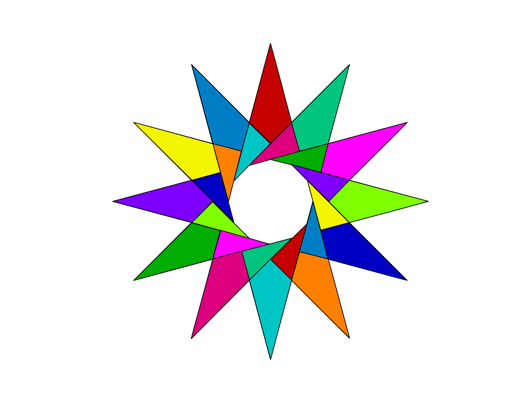
For us, it conveys, through line and color, the movement and harmony of musical and therapeutic relationships—the patterned connection between the notes of the scale arranged chromatically and by 5ths, and the patterned connection between problems and solutions.